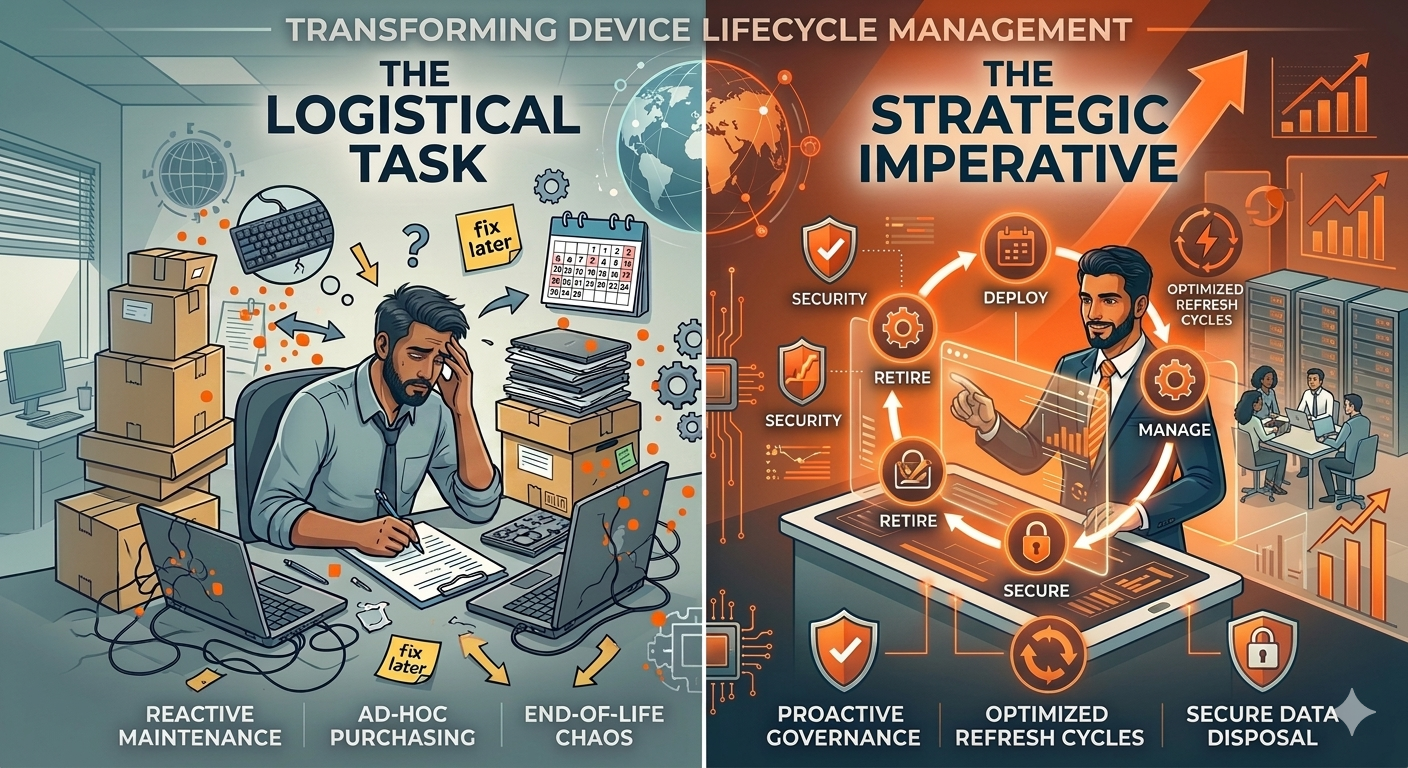
For most IT teams, the endpoint lifecycle is easy to describe.
You buy a laptop, configure it, deploy it, support it for a few years, then replace it.
Simple enough.
But here's the problem: when we think of the lifecycle as a series of operational steps, we tend to measure whether each step was completed—not whether it created value.
The laptop was deployed.
The support ticket was closed.
The warranty expired.
The device was replaced.
Those are activities. They don't tell you whether your organization got the most from its investment.
A better way to think about the endpoint lifecycle is as a value chain. Every decision—from the day a device is purchased until the day it's retired—either adds value or quietly erodes it.
That's the difference between managing endpoints and managing endpoint value.
When people hear the word value, they often think about resale price.
That's part of the equation, but it's hardly the whole story.
A laptop creates value every day it enables someone to do their job. It loses value when performance slips, support costs increase, downtime becomes more common, or the device no longer meets the needs of the person using it.
Viewed this way, the endpoint lifecycle becomes something more than an operational workflow. It becomes a series of decisions, each with consequences that extend well beyond IT.
The question shifts from:
"How old is this laptop?"
to something much more useful:
"Is this laptop still delivering the value we expected?"
That single question changes how organizations approach every stage of the lifecycle.
The first opportunity to create value happens long before an employee opens a new laptop.
Choosing the least expensive model isn't always the lowest-cost decision. Likewise, buying premium hardware for everyone often means paying for performance that many employees will never use.
The objective isn't to minimize purchase price.
It's to match the device to the work.
A software developer, graphic designer, finance analyst, and field technician all have different requirements. Getting that decision right improves productivity, simplifies support, and extends the useful life of the device.
It's also why procurement shouldn't be viewed as a purchasing exercise alone. It's the first opportunity to influence the total value the organization will receive over the next four or five years.
A laptop sitting in a shipping box has no practical value.
Its value begins when someone can use it to do meaningful work.
Modern deployment tools have made provisioning dramatically easier, yet many organizations still lose time to small problems—missing applications, configuration errors, manual setup steps, or delays getting devices into employees' hands.
Individually, these issues seem minor. Collectively, they slow onboarding, consume IT resources, and delay productivity across the organization.
Deployment isn't simply about getting devices out the door. It's about reducing the time between receiving a device and getting productive with it.
Most endpoints spend years in active use. This is also where value tends to erode gradually. Performance declines. Batteries wear down. Storage fills. Warranty coverage expires. Support requests become more frequent. None of these changes is especially concerning on its own.
Together, they tell a story.
The challenge isn't that IT lacks data. Most organizations already collect plenty of it. The challenge is that the signals often live in different systems and are viewed independently.
Battery health says one thing.
Warranty status says another.
Support history tells a third story.
Taken together, they provide a much clearer picture of whether a device is still delivering the value it was expected to provide.
That's a very different question than simply asking whether it's still working.
Few lifecycle decisions have a greater financial impact than deciding when to replace a device.
Many organizations still rely on age-based refresh cycles because they're predictable and easy to budget.
But age is only one signal.
A four-year-old laptop with excellent performance, a healthy battery, and very little support history may still have years of productive life ahead of it. Meanwhile, a newer device with recurring hardware issues may already be costing more than it's worth.
A better refresh strategy considers age alongside device performance, repair history, battery health, support costs, and whether the device still meets the employee's needs.
That doesn't mean replacing devices earlier. It doesn't mean keeping them longer. It means making replacement decisions based on evidence instead of averages.
The same thinking applies to repairs. The question isn't whether a laptop can be repaired. It's whether repairing it creates more value than replacing it.
That's a very different conversation.
Too often, retirement is treated as the end of the lifecycle.
In reality, it's the final opportunity to capture value from the investment.
Some devices can be redeployed internally. Others still have resale value. Even equipment destined for recycling should be handled in a way that protects sensitive data while recovering as much value as possible.
Organizations that think about retirement before a device reaches end of life consistently make better decisions than those treating it as an afterthought.
Like every other phase of the lifecycle, retirement isn't just about completing a task.
It's about making the best decision with the value that remains.
Traditional endpoint management focuses on operational milestones.
Was the laptop deployed?
Is it patched?
Is it encrypted?
Was it retired securely?
Those questions will always matter. But they don't answer the bigger one:
Is this device still creating value for the organization?
That's where endpoint value management begins.
It doesn't replace endpoint management. It builds on it. The operational data IT teams already collect—device health, support history, warranty status, repair costs, performance, utilization—can be used to make better decisions throughout the lifecycle.
Procurement becomes more intentional. Support becomes more proactive. Refresh planning becomes easier to justify. Retirement becomes an opportunity to recover value rather than simply dispose of equipment.
The lifecycle itself hasn't changed. The way we think about it has.
Every organization manages endpoints.
The organizations that consistently get more from their technology investments do something slightly different.
They recognize that every lifecycle decision—large or small—affects the value they receive from each device.
That's a subtle shift in perspective.
But over thousands of endpoints and years of operation, it has a meaningful impact on costs, employee productivity, refresh planning, and the overall return on technology investments.
The endpoint lifecycle isn't just a process to manage.
It's a value chain to optimize.
Endpoint lifecycle management is the process of planning, purchasing, deploying, supporting, refreshing, and retiring employee devices throughout their useful life.
Endpoint value management is the practice of making lifecycle decisions based on the value a device delivers—not simply its age. It considers factors such as performance, reliability, support costs, employee productivity, and remaining useful life.
Device age is one factor, but it shouldn't be the only one. Better replacement decisions also consider performance, repair history, battery health, support costs, warranty status, and whether the device continues to meet the employee's needs.
Every endpoint is an investment. Managing that investment throughout its lifecycle helps organizations improve employee productivity, reduce unnecessary support costs, make more informed refresh decisions, and recover more value when devices are retired.





.png)